
Thermal spray & coatings Flagship application
Parameters → coating → micrograph → model → next recipe → spray path.
Thermal and cold spray is where every capability of Patok Lab meets: a campaign of spray runs, the cross-sections they produced, the porosity and thickness measured from them, the surrogate that explains the response, the next recipe — and the raster that sprays it.
The loop, on a spray booth
- 01
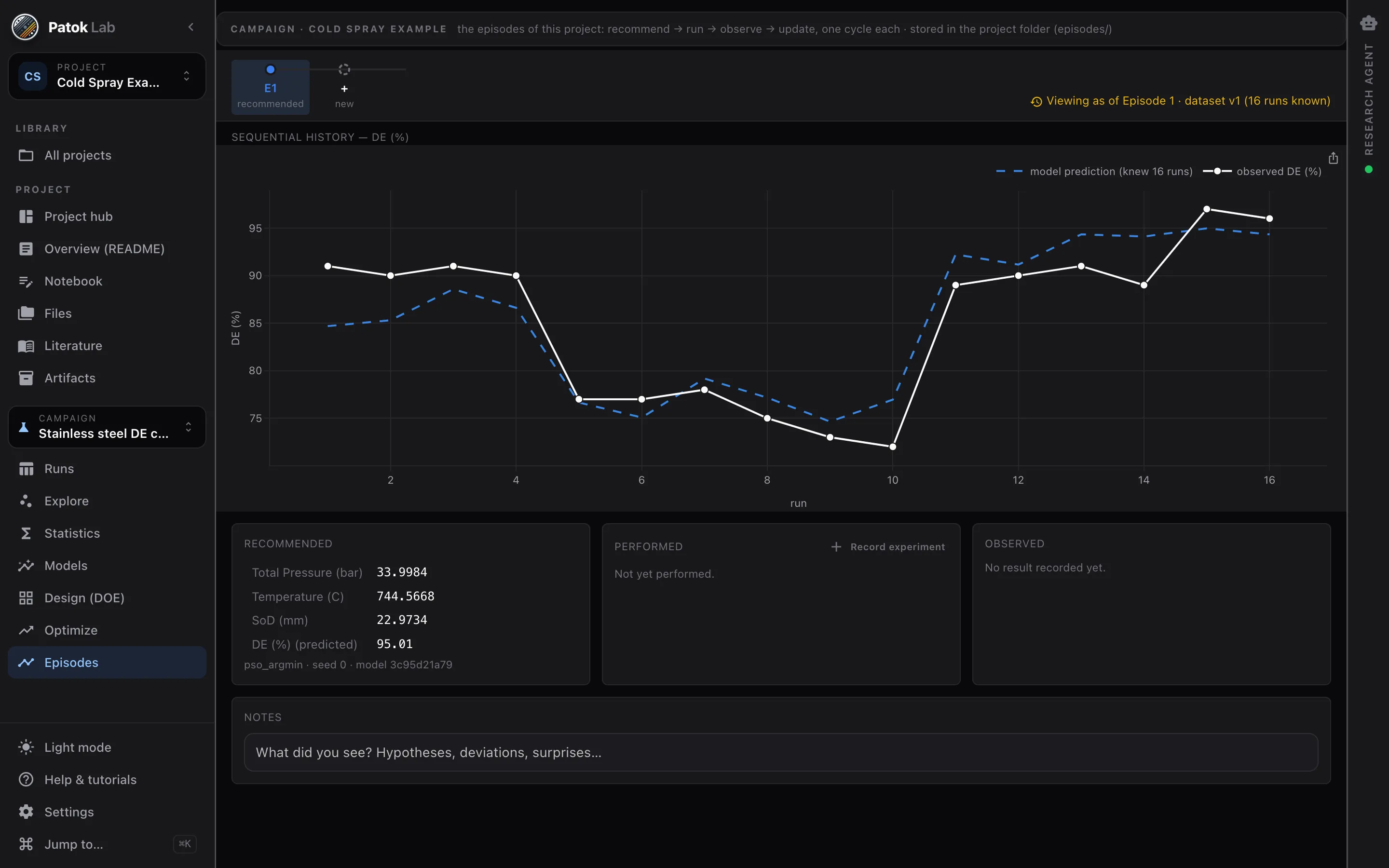
The campaign
Pressure, temperature, stand-off, gun speed as inputs; deposition efficiency, thickness, porosity as responses. A real 16-run coating campaign ships as an example.
- 02
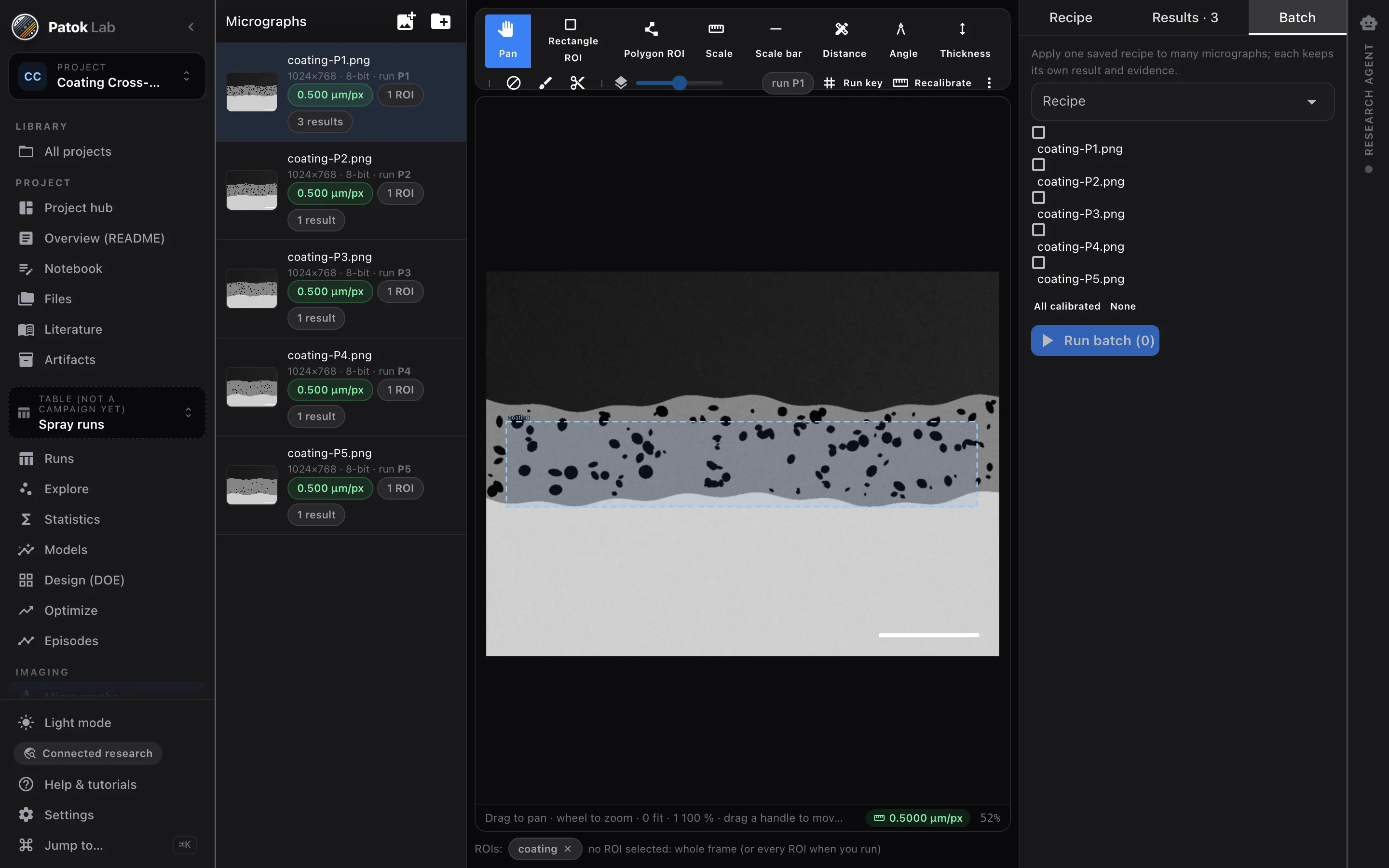
The cross-sections
One micrograph per run: calibrated, one recipe, porosity and thickness normal to the interface, batch mean and spread, straight into the runs table.
- 03
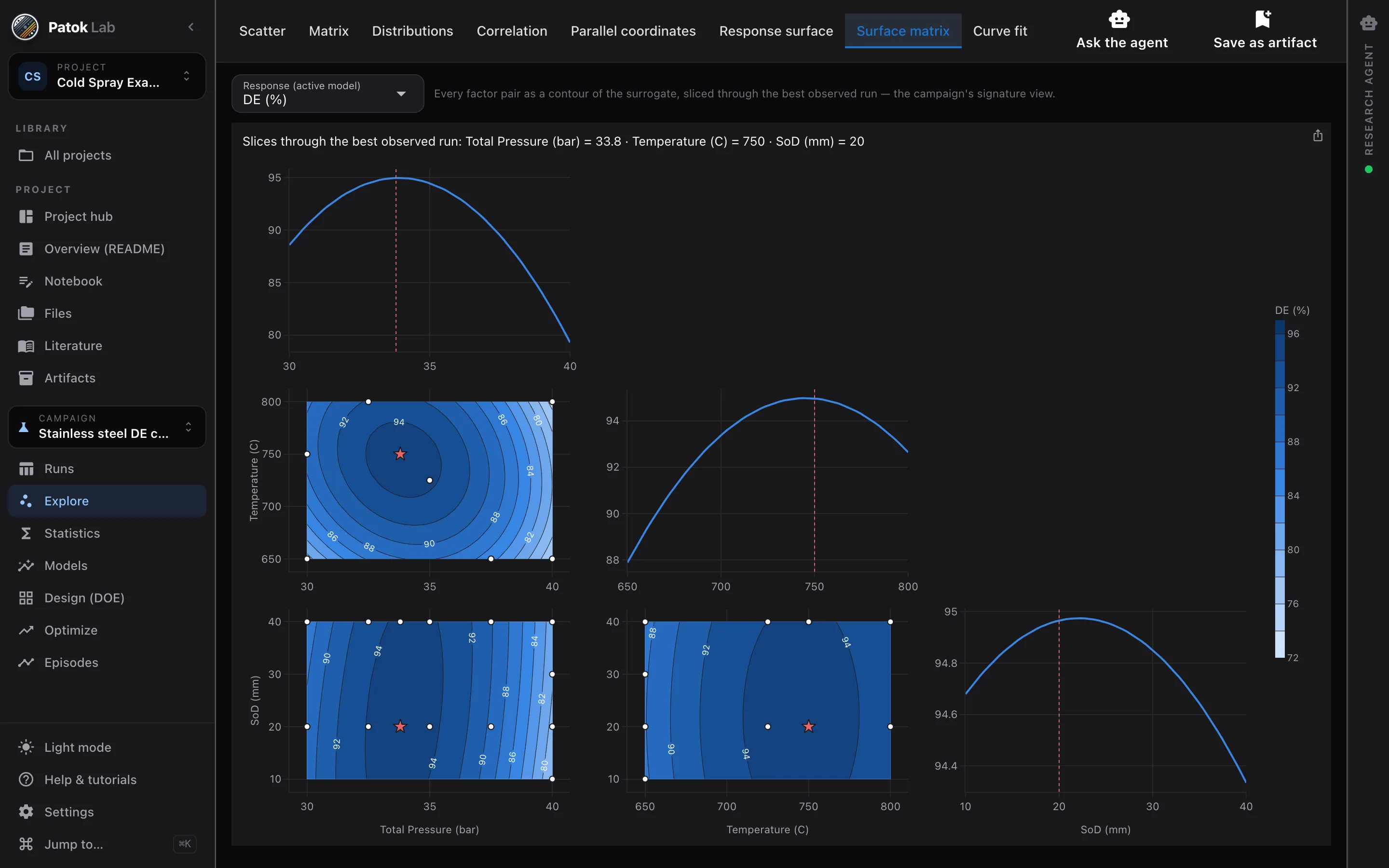
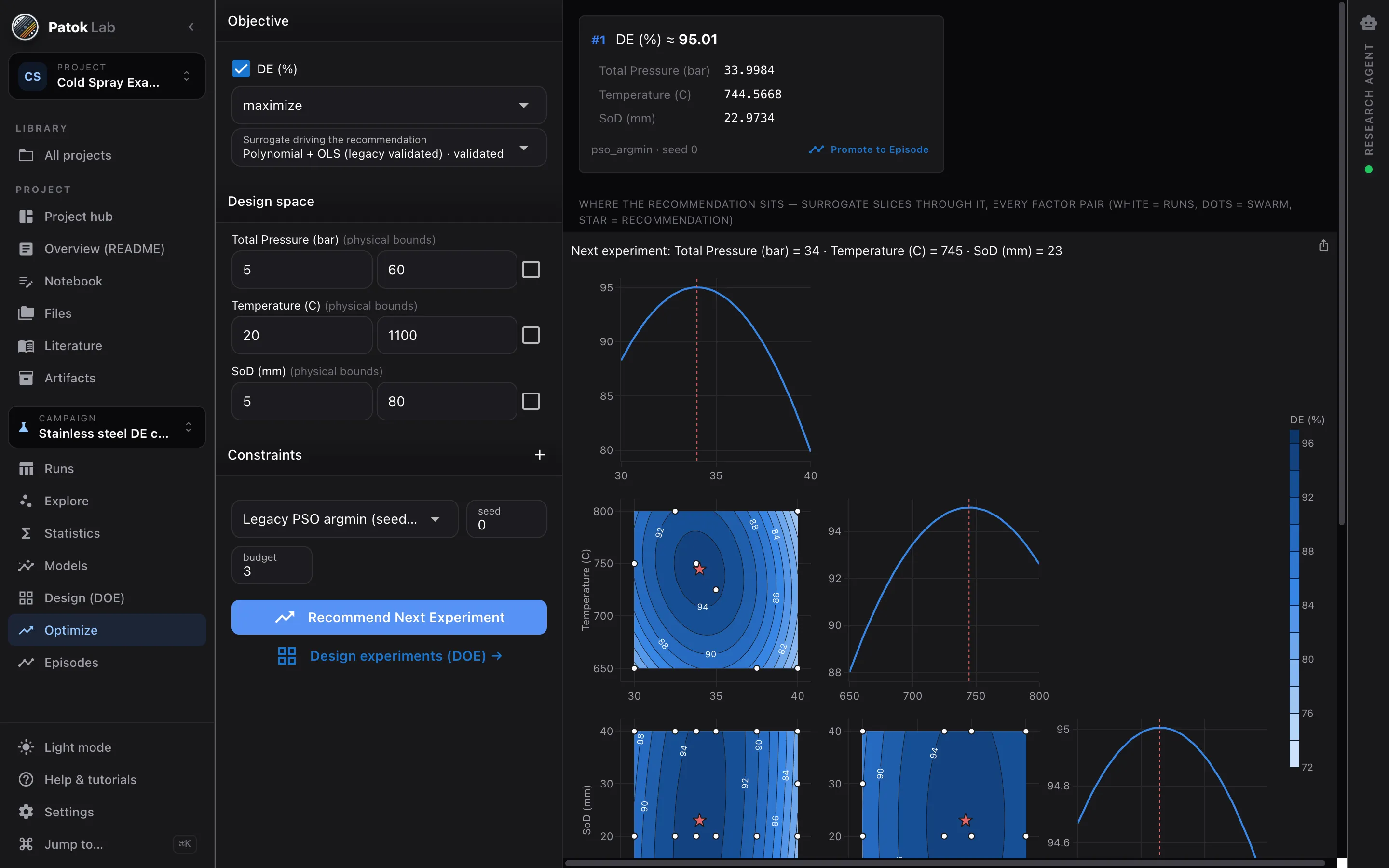
The model and the next recipe
A surrogate on the runs, verified; the optimizer proposes the next parameter set inside the booth’s bounds, with the predicted response.
- 04
The path
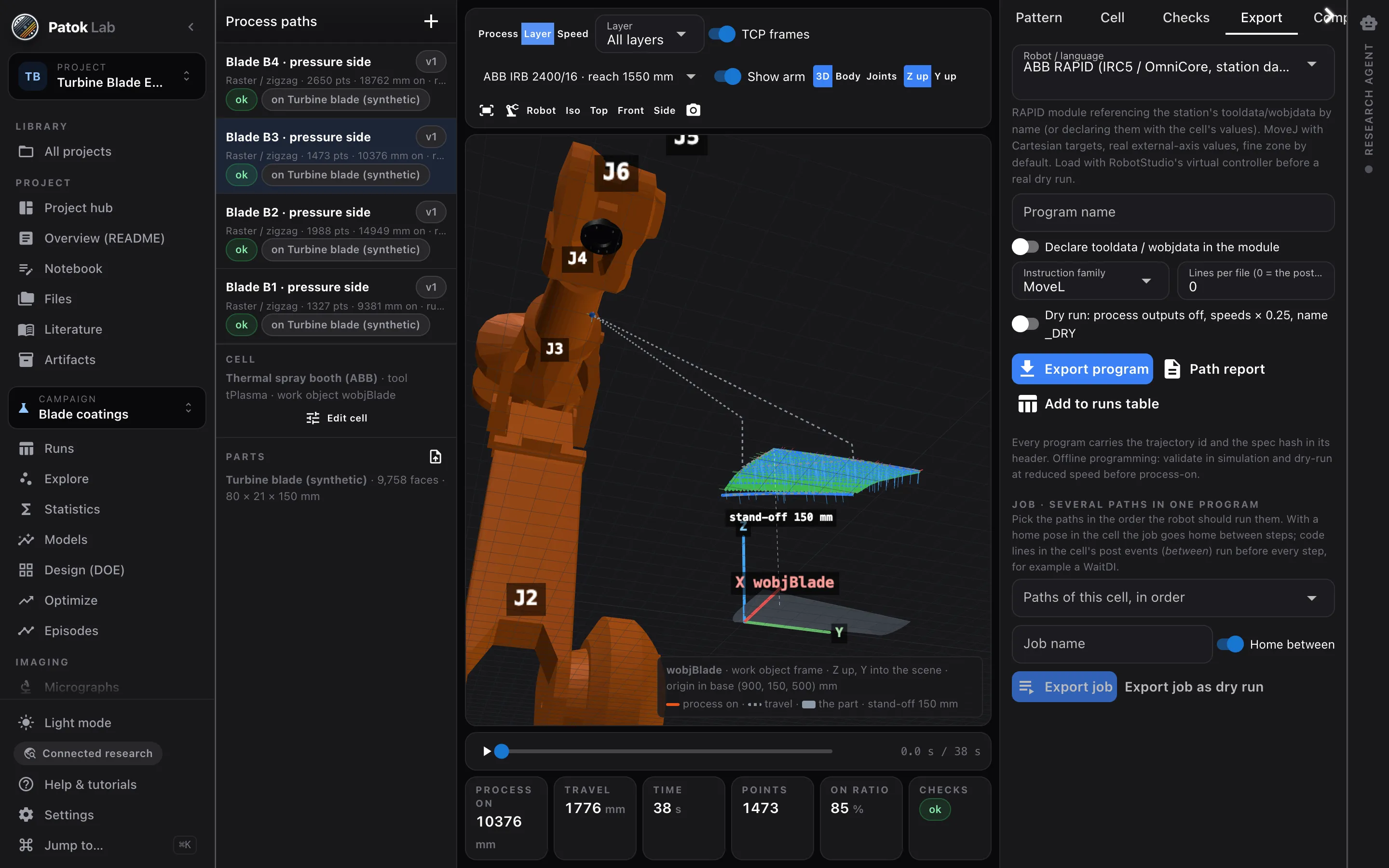
A raster on the coupon — or thermal spray on a turbine blade’s pressure side, layers turned ninety degrees — checked against your cell and exported for your robot.
Already in the app
- Cold-spray campaign example (the real published 16-run dataset), powder adhesion, coating-thickness SPC.
- Coating cross-section example: five spray runs, porosity and thickness to the table.
- Raster coupons, turbine-blade rasters, and the blade held by the robot in front of a fixed plasma gun.
- Metal Knitting for thin walls, corner filling into chamfers, WAAM-style cooling pauses.
What it is not
- Not a spray-physics simulator: no particle velocity or temperature model. The method is agnostic to the physics it does not encode, which is why it transfers between systems.
- Imaging metrology, robotic process paths and the campaign tools are all shipping today.
Who this is for
Thermal-spray labs
Parameter windows for a new powder or substrate, with the cross-sections measured the same way every time.
Coating shops and MRO
A qualification campaign that converges, a capability study from the production log, a repair path on the part.
Cold spray and additive
Deposition efficiency campaigns, build-ups, Metal Knitting walls, the next experiment recommended.
Early access
Early access for people who run real processes — labs, engineering teams and shops.
Bring a customer drawing, a table of runs, a folder of micrographs or a part you spray, weld or mill. We want Patok Lab used on live work and told what breaks. The Community edition is free, with no time limit; macOS, Windows and Linux.
- macOS, Windows and Linux — tell us which one you need first
- Direct line to the founder during early access
- Optional workshop for your group or team: bring a job, leave with an artifact
- 01Tell us what you would bringA drawing, a table of runs, a folder of micrographs, a part, a line.
- 02The build arrives by e-mailInstaller, a licence you paste once, and a short guide for the bench you came for.
- 03Reply with your fileWe look at it before we send it, and a person answers — not a form.
Get access Bring a drawing, some photos, a table or a part. Or just tell it.
Bringing it to a team, a shop or a university group? Ask for your team →
FAQ
Questions engineers and researchers ask first.
Is Patok Lab a Cold Spray tool?
Thermal and cold spray is the flagship application because the whole loop is exercised there. The engine is generic: any table of inputs and measured responses, any micrograph with a known scale, any pattern on a region.
Which spray guns and robots?
The tool is a sketch you edit from your gun; presets exist for spray guns and cold-spray nozzles. Robots: ABB, FANUC, KUKA, Yaskawa, UR and a custom DH table; the robot can hold the part in front of a fixed gun.
Can you help set it up on our booth?
Yes — a workshop on your own campaign data and your own cell. Tick the workshop box in the form.