
Discrete-event simulation Available
Ask what the line would do before you change it.
Entities through resources, queues and buffers: cycle times, setups, failures, shifts, batching, dispatch and release policies. Run it, replicate it with confidence intervals, compare two scenarios side by side, and let the optimizer search the policy — all from a model you can read and edit.
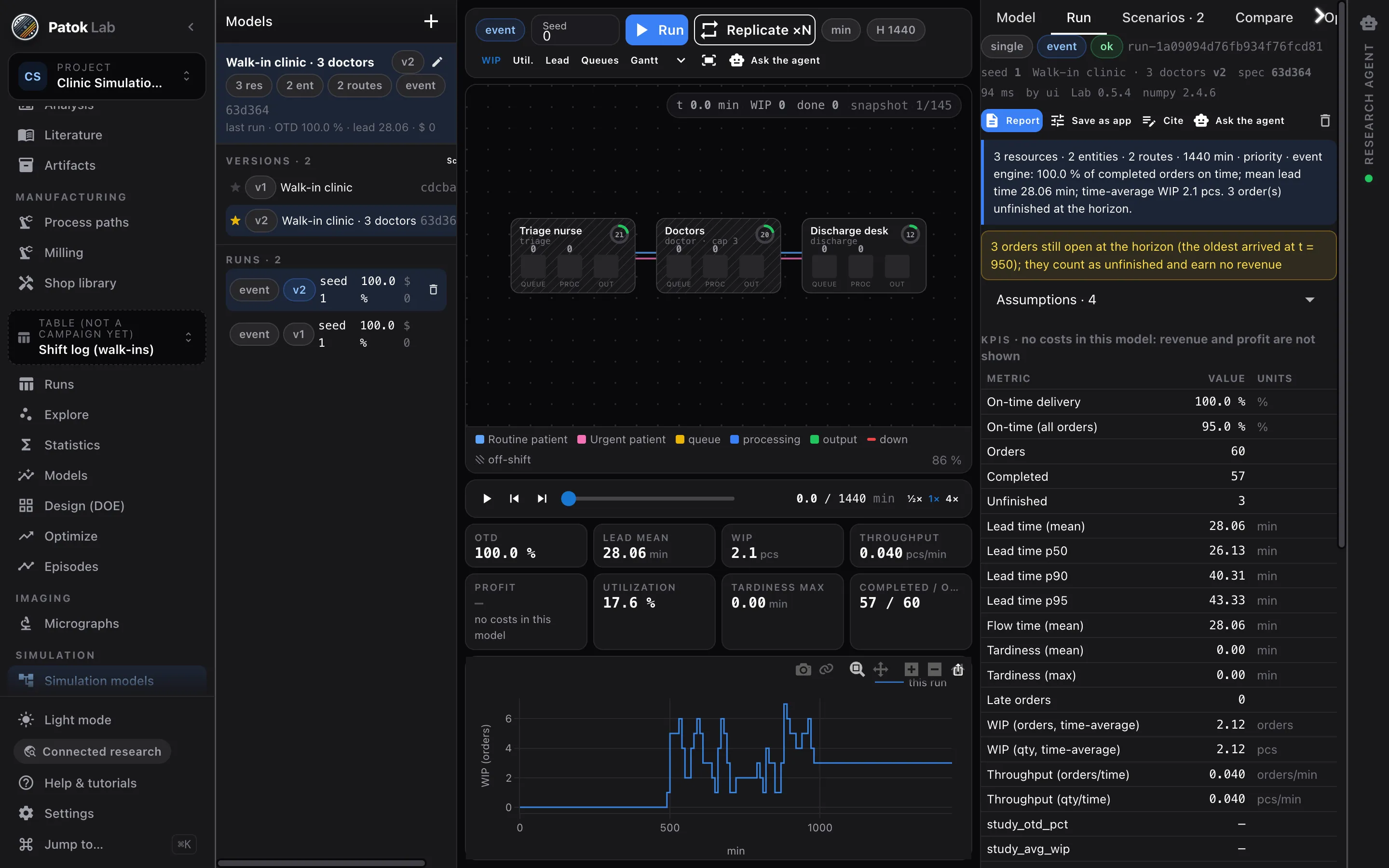
Model → run → replicate → compare → optimize
- 01
Describe the flow
Resources with cycle times, setups and failures; queues, buffers and blocking; shifts and batching; the release rule and the dispatch rule. Distributions where you have them: constant, triangular, normal, lognormal, exponential, Erlang, empirical.
- 02
One run is one seed
A single run is a sample, not an answer. Replicate it and you get a mean and a confidence interval instead of a number that changes every time you press Run.
- 03
Compare, then optimize
Two scenarios in one call, with the differences that matter highlighted. When the question is a policy rather than a scenario, the optimizer searches it — seeded, so the answer reproduces.
- 04
It is a capability like the others
The model has a Code tab: the exact calculation that ran when you pressed Run. Results are artifacts with provenance, and they can go into a runs table, a report or a live app artifact that asks for new runs.
What is in the app today
- A repeatable, seeded engine: the same inputs give the same answer
- Replications with a mean and a confidence interval, not one lucky run
- Scenario comparison in one call, and PSO for policy search
- Release rules: immediate, EDD backward, offsets, CONWIP
- Dispatch rules: FIFO, EDD, SPT, LPT, priority, critical ratio
- A published factory-flow study reproduced bit-exact as a verification fixture
- Every run a `simulation-result` artifact, with its assumptions listed
Before the spindle turns
- This is discrete-event and queueing, not physics: no CFD, no FEA, no thermal solver.
- A replica of a published study is a replica of its model, and every gap between the paper and the code is listed as an assumption on the run.
- A simulation is as good as the times and the rules you put in it. The app will not invent them for you.
Typical starting points
One more machine, or one fewer?
Model the cell as it runs today, then ask what the queue does when you add capacity — with a confidence interval, not a single run.
A release rule you argue about
CONWIP against immediate release on the same instance, same seeds, side by side.
A clinic, a counter, a warehouse
It is not only factories: anything where entities wait for resources behaves the same way.
A study you want to check
Reproduce a published model, see where your numbers differ, and read the assumptions the replica had to make.
Early access
Early access for people who run real processes — labs, engineering teams and shops.
Bring a customer drawing, a table of runs, a folder of micrographs or a part you spray, weld or mill. We want Patok Lab used on live work and told what breaks. The Community edition is free, with no time limit; macOS, Windows and Linux.
- macOS, Windows and Linux — tell us which one you need first
- Direct line to the founder during early access
- Optional workshop for your group or team: bring a job, leave with an artifact
- 01Tell us what you would bringA drawing, a table of runs, a folder of micrographs, a part, a line.
- 02The build arrives by e-mailInstaller, a licence you paste once, and a short guide for the bench you came for.
- 03Reply with your fileWe look at it before we send it, and a person answers — not a form.
Get access Bring a drawing, some photos, a table or a part. Or just tell it.
Bringing it to a team, a shop or a university group? Ask for your team →
FAQ
Questions engineers and researchers ask first.
Do I need to know simulation to use it?
You need to know your process. The model asks for the things you already say out loud: how long a step takes, how often it fails, what the queue does when it is full, how work is released. The statistics of replication are handled for you.
Can I see the code?
Yes — every capability has a Code tab showing the exact calculation that ran when you pressed Run, and for capabilities you promote yourself you can edit it, test it in a separate interpreter and save it as a version.
Is it connected to the rest of Patok Lab?
Yes. Results are artifacts with provenance, they can become columns in a runs table, and a campaign can vary the model’s parameters the same way it varies a spray recipe.